MIT remembers Thomas Rose, a brilliant researcher and generous colleague
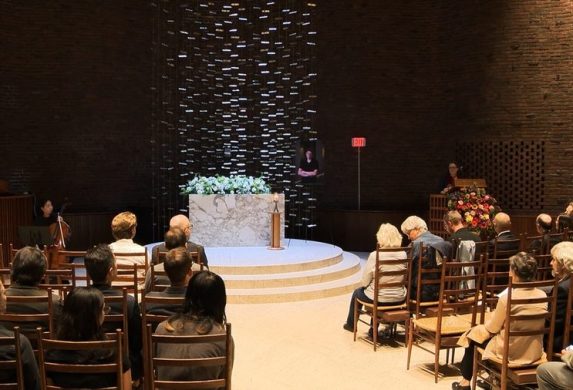
More than 100 people filled the MIT Chapel on Sept. 24 to pay tribute to Assistant Professor Thomas Rose, the MIT archaeometallurgist who died last month following a bicycle crash in Cambridge, Massachusetts.
Faculty, students, and staff affiliated with the Department of Materials Science and Engineering (DMSE) and the Center for Materials Research in Archaeology and Ethnology (CMRAE), along with family and friends, gathered for a memorial service where colleagues spoke about the 37-year-old, who joined the DMSE faculty in January and had just started building a research program at MIT. They remembered him as a brilliant researcher and generous colleague with an extraordinary breadth of expertise and eclectic passions ranging from rowing to archery.
A portrait of Rose sat on an easel next to the chapel’s flower-covered altar. A cellist played as guests entered and took their seats.
Chaplain to the Institute Thea Keith-Lucas opened the service by reflecting on the loss felt across MIT.
“We honor the unique gifts that he brought to this world. We honor the ways that he was growing, and the possibilities that were cut short. We honor the small, unseen moments of courage and connection that create a life,” she said.
Finding a unicorn
To give a sense of what Rose meant to DMSE, department head Polina Anikeeva briefly explained archaeometallurgy — the study of how ancient societies produced and used metals — and its development at MIT, beginning in the 1960s. The field flourished after the establishment of CMRAE in the 1970s, but over the following decades it began to contract in the United States, and MIT had difficulty finding people with an increasingly rare set of skills.
“We were looking for a unicorn. We were looking for two decades,” Anikeeva said. When Anikeeva and other DMSE faculty reviewed Rose’s resume in 2025, they were impressed by his unique training in geoscience, metallurgy, and archaeology and met him soon after. “We saw a brilliant, creative colleague — unassuming, intellectually fearless, adaptable, resourceful, and eagerly looking into the future.”
Mike Tarkanian, senior lecturer in DMSE and associate director for CMRAE, described the Zoom interview with Rose that kicked off the faculty search. Rose spoke fluently about his work, interests, and research vision — without the slides or notes that candidates typically rely on.
“I hung on every word — but it was so unusual and so risky that I wasn’t sure how it would be received,” Tarkanian said. “As soon as the call ended, my phone rang and it was a colleague who was also on the Zoom and he said, ‘That’s our guy. That has to be our guy.’”
Anikeeva also spoke of the enthusiasm he brought with him every day at MIT, noting his “almost childlike curiosity and his enormous positivity.”
“There were no obstacles, only opportunities and possibilities.”
To honor Rose and carry forward the work he had begun at MIT, Anikeeva said DMSE would launch the Thomas Rose Fellowship for Excellence in Archaeometallurgy, dedicated to supporting the most promising young scholars at the PhD and postdoctoral levels, “so that we can continue this field for the world and for the U.S. and for the memory of Thomas.”
A generous spirit
Speakers also remembered Rose’s kindness, generosity, and empathy toward everyone around him. Tarkanian stressed Rose’s commitment to community and helping others, noting his contributions to research tools used by archaeologists worldwide. He gave an example from Rose’s undergraduate years in his native Germany, when he gave tutorials for first-year archaeological science students who were struggling with chemistry and math. A former student told Tarkanian that an email Rose sent inviting students to the tutorial ended with, “I guess I’ll be more nervous than you folks tomorrow.”
“This was the Thomas we only started to get to know,” Tarkanian said, “someone who offered his expertise to others in need without question, while being thoughtful enough to worry out loud that he might be the nervous one and, by doing so, putting others at ease.”
DMSE Assistant Professor Tania Lopez-Silva, who started at MIT six months before Rose, recalled his patience and understanding. When she arranged a lunch with him, he said he would eat anything but mushrooms and eggplant.
“Somehow I misunderstood him, and I chose the place that probably has the most mushroom and eggplant options possible,” Lopez-Silva said. “He said that he still wanted to try the place, and he would find something to eat. That was Thomas — kind, patient, open-minded, and always willing to make the best of things.”
That quality came through in a story by another DMSE faculty member, Assistant Professor Thomas J. Wallin, who recalled a photo Rose had sent him of the apartment he had found overlooking the Charles River. Wallin was impressed, but Rose said with characteristic directness that it was quite small, but “very long and narrow” — which turned out to be a good thing.
“He explained that because it was narrow, he could stand at the edge of his balcony and shoot at his archery target through his hallway, past his kitchen, at his door, and it would be the proper distance,” Wallin said, drawing chuckles in the chapel. “I don’t think that’s a request many Boston realtors get, but that was Thomas.”
Rose’s connections also extended beyond DMSE. Katya Tiukhtikova, joined by fellow MIT Archery Club member Kiarra Ning, remembered how Rose treated others.
“He only focused on the good in people, and gave everyone a chance to show the best parts of themselves,” Tiukhtikova said.
She also recalled the contagious excitement Rose brought to archery practice, saying he “always brightened the days of everyone who was lucky enough to share the archery range with him.”
Tarkanian ended his remarks with a reflection on academic life and the importance of generosity and humility alongside brilliance and achievement.
“If part of Thomas’s legacy here at MIT is that we become a little more generous with our time, a little more humble about our accomplishments, and a little more deliberate about building communities in which other people can thrive and grow, that would be a legacy worthy of him.”