DMSE to welcome new faculty member Manasa Kaniselvan
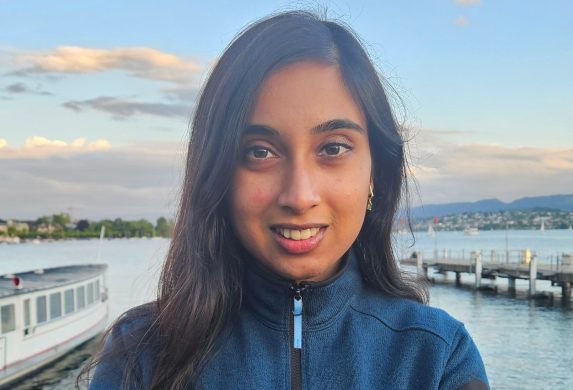
MIT’s Department of Materials Science and Engineering (DMSE) will welcome Manasa Kaniselvan as a new faculty member in July 2027. Kaniselvan develops and uses computational tools to understand and design next-generation semiconductor devices.
Kaniselvan is a research scientist in the Department of Information Technology and Electrical Engineering at ETH Zurich in Switzerland. Her research focuses on modeling semiconductor devices “from the atoms up”—an approach that considers both the materials the devices are made from and how they’re built. Her work aims to enable more energy-efficient computing and new types of memory.
She will join DMSE as an assistant professor, with a shared appointment in the Department of Electrical Engineering and Computer Science (EECS) through the Schwarzman College of Computing.
“We’re thrilled to welcome Dr. Kaniselvan to DMSE,” said Department Head Professor Polina Anikeeva. “Her computational innovations are poised to fundamentally change how we think about electronic materials design in research and education.”
Kaniselvan earned her bachelor’s degree in nanotechnology engineering and her master’s in electrical and computer engineering at the University of Waterloo in Canada. She recently completed her PhD studies at ETH Zurich in Switzerland.
As an undergraduate student, she became interested in the atomic structure and electrical properties of materials. During her master’s studies, she explored computer simulations of semiconductor devices such as transistors and memory cells. Her interests shifted further toward materials science during her PhD, as she began investigating how the structure and composition of the materials inside these devices affect their behavior.
“At the level that we’re looking at today, this is becoming less high-level physics modeling and more materials science,” Kaniselvan said.
In her current research, she develops computational tools to understand how electrical currents flow through semiconductor devices at the atomic level, helping researchers identify ways to improve their performance.
At DMSE, Kaniselvan plans to use these computational methods to answer questions about the materials in increasingly small semiconductor devices. For example, she wants to understand how interfaces, or boundaries between materials, affect the flow of electricity and how that knowledge can help researchers engineer better devices.
In the longer term, she hopes to rethink how computer chips are designed, exploring how materials can be engineered to take on computing functions currently performed by transistors and their interconnecting components.
“Can we redesign things at a higher level?” Kaniselvan said.
Kaniselvan was drawn to MIT’s collaborative academic environment and DMSE’s strong reputation for materials research. She’s looking forward to working with MIT’s talented students and returning to the Boston area, where she lived in 2017 for eight months while completing an undergraduate internship at a Harvard startup. She also likes the “general academic vibe” of the East Coast and the sense of history around MIT’s campus.
“And I know the running routes in the area,” said Kaniselvan, who describes herself as a hobbyist runner, cyclist, and skier.
“We cannot wait to see what exciting program Manasa builds here at DMSE,” Anikeeva said.
Related Stories