Dipping into glazes, a ceramic scientist finds his community
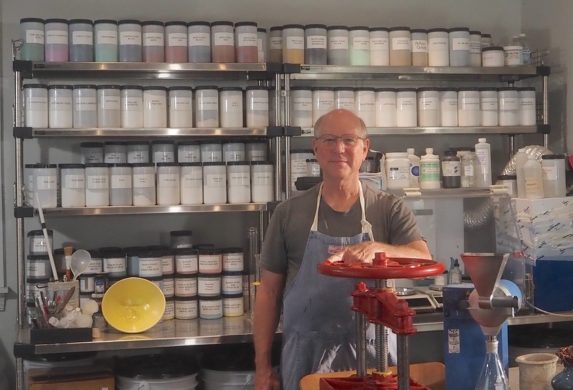
Howard Sawhill SM ’81, PhD ’85 started down his post-retirement path 10 years ago when he took a summer workshop on ceramic glazes. It was a topic he’d never had the chance to explore during his ceramics-focused materials science studies at MIT, nor in his three-decade stint as a manager at DuPont specializing in R&D for electronics applications.
On the workshop’s final day, Sawhill asked the instructor for examples of unanswered questions in the field. “His response was to show me a picture of a 13th-century piece of Chinese Guan pottery with what we call a crackle glaze,” he says. Such glazes gain visual interest from “crazing,” fine fractures that typically occur in a grid-like formation. Sawhill’s instructor pointed out the unusual single line spiraling up the vase’s slim neck and challenged: “Explain that.”
Sawhill spent months attempting to do so. “That’s the kind of problem that intrigues me,” he says. Along the way, he learned how to apply the mathematical concept of boundary conditions to mechanical models of crazing in ceramics and discovered a method of producing unusual crazing patterns he later shared in the journal Studio Potter.
“I was itching, after thirty years of being away from the bench, to start doing some of my own investigative research,” he says. He converted a two-car garage at his North Carolina home into the headquarters of Cone Blue Pottery, a studio devoted to the science behind ceramic glazes.
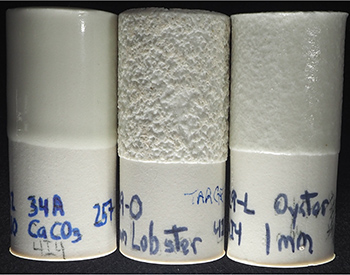
Some of the studio’s projects are motivated by pure curiosity, like Sawhill’s recent experimentation with grinding up lobster shells and other “beach treasures” to produce new textures. He also seeks out potters having difficult glaze issues.
For example, he helped a potter puzzle out why half the plates she’d made came out of her kiln brown, while the rest were blue. Methodically, he ruled out one potential cause after another, considering multiple theories proposed by fellow potters. Then, by chance, a test sample ended up being both blue and brown. He recalls thinking, “This is what I’ve been waiting for!”
He cut up the sample with a diamond saw, examined it under the microscope, and discovered the underlying cause of the variation was a very minor change in glaze thickness. Timing the potter as she swirled glaze around each plate, he determined 17 seconds was the magic number needed to ensure all the plates were blue, enabling her to fulfill a large restaurant order on time.
“I love collaborative work,” he says. “The deal is: I get to publish, and they get free advice.”
Monetizing Cone Blue Pottery’s output isn’t Sawhill’s priority; the venture yields other rewards, like entrée into NCECA (the National Council on Education for the Ceramic Arts), whose annual conference attracts thousands of attendees. “That’s my new community,” he says. “I can go up to anyone there and in thirty seconds, we’re having a conversation.” Such openness, “from beginners all the way up to the experts,” is something he rarely encountered at technical conferences in his corporate career. But it reminds him very much of his time at MIT.
“MIT gave me the space to learn how to do original science,” he says, “and the support of being surrounded by experts and inquisitive fellow graduate students who were very accessible. I could walk right into the offices of professors, and they would stop what they were doing, listen to my concerns, and have a serious discussion. What better environment to be in?”
Cone Blue Pottery has turned Sawhill into a teacher as well. After offering a few glaze troubleshooting workshops to a niche audience of professionals, he’s found unexpected satisfaction leading clay hand-building classes for senior citizens.
“I’m able to explain to them how things work from the material standpoint, but they are the artists,” Sawhill says. “It’s a lot more fun to be with people doing art than being the professor in front of the class with all the answers. I’m learning that I can use the science to help spread what people really need: the joy of discovery while making something beautiful.”