An engineer’s guide to birds

Feathers give birds their dazzling colors. They repel water and trap heat, keeping them warm and dry. They can even stifle sound, allowing species such as owls to hunt in virtual silence.
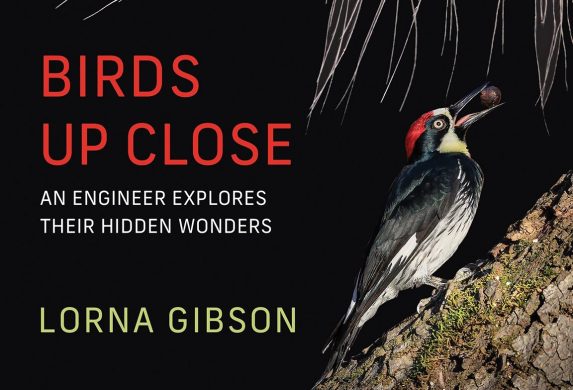
All of these functions come from the remarkable structure of feathers, explored in two chapters in “Birds Up Close,” by MIT materials engineer and lifelong birder Lorna J. Gibson. The book takes a microscopic look at birds’ feathers, bones, bills, eggs, and the mechanics of flight to explain their extraordinary abilities — how they can hover in place, silently swoop down on prey, and fly hundreds of miles without tiring.
Gibson spent four decades studying the mechanical behavior of materials — examining their underlying structure to determine what makes them hard or soft, supple or brittle. She specialized in cellular materials, such as engineered honeycombs and foams, as well as natural ones such as wood and bamboo.
Now a post-tenure professor, she’s turned her materials engineering perspective to birds, a subject that has long fascinated her. She’s given talks on the properties of feathers, including the Department of Materials Science and Engineering’s Wulff Lecture in 2017, and studied how sandgrouse carry water in their feathers to their young and how woodpeckers avoid brain damage despite their constant battering.
As a graduate student, she recalls, a colleague told her that woodpeckers have foam between their skulls and brains to cushion the blows of pecking. Intrigued, she dug into the topic and discovered a 1976 study in which neurologists dissected a woodpecker’s head and found no foam at all. So how do woodpeckers avoid brain injury?
“Eventually I recognized that because woodpeckers have such tiny brains, they don’t need the kind of protection that larger animals would need,” Gibson writes in the preface. That understanding led to talks for birders — and eventually to the idea for a whole book explaining how birds work through the lens of materials science and mechanics.
Engineering meets birding
Gibson describes “Birds Up Close,” published by MIT Press and scheduled for release May 5, as a book by an engineer for anyone interested in birds, drawing largely on published research. Readers need no scientific or engineering background; sidebars include calculations for those who want more detail.
“I wasn’t writing it for engineers; I was writing it for birders — people who are curious about natural history,” she says. “I think engineers will enjoy it because there are engineering pieces to it, but I really wrote it for birders.”
Birding has surged in popularity in the United States; 96 million people — about one in three Americans — consider themselves birders, according to the U.S. Fish and Wildlife Service.
Those readers will find no shortage of memorable facts. Two chapters on feathers, titled “Fantastic Feathers,” explore striking features such as the wood duck’s brilliant colors and hummingbirds’ iridescence. Gibson explains both the science behind feather colors and how we perceive them.
“The color we see comes from light that is reflected from a surface,” she writes, describing the pigments responsible for the blacks and grays of seagulls as well as the vibrant reds and greens of the African turaco. But the blue jay in your backyard gets its color another way: blue is not a pigment at all, but a structural color, produced by the interaction of light with microscopic structures within the feathers.
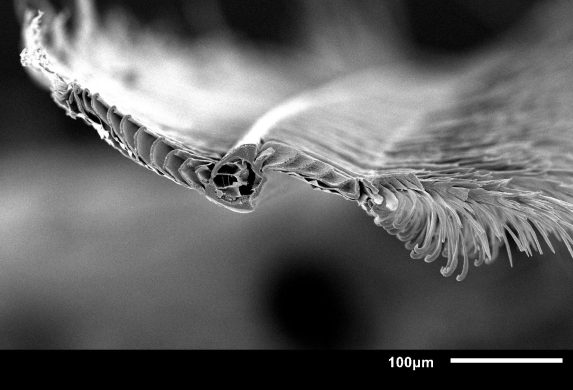
Using photography, sketches, and microscope images, Gibson examines the microscopic structures of feathers. The contour feathers covering a bird’s body, for example, are branched structures with connecting barbs and parallel barbules. Scanning electron microscope images reveal details invisible to the naked eye, including the foamy core of a feather shaft.
She uses the same approach to explore how male hummingbirds produce high-pitched buzzing sounds with their tail feathers during dramatic courtship dives. The sound comes from the fluttering edges of the outermost tail feathers — like blowing across a blade of grass.
Gibson also shows how barn owl feathers enable stealthy flight. Comb-like serrations on the wing break up airflow and reduce noise.
Richard Prum, an ornithologist at Yale University who contributed images to the book, says Gibson’s engineering perspective deepens how we think about birds and evolution. Prum, author of “The Evolution of Beauty,” notes that her approach helps explain not just how birds survive, but how their unique features evolve and function.
“The public has absorbed generations of statements about survival and adaptation and ecology,” Prum says. “But that really sweeps under the rug, how do birds do it?”
Each chapter focuses on a different feature and can be read independently — readers can skip to the second feathers chapter to learn how water literally rolls off a duck’s back, or to the bills chapter to explore the bristles on a woodpecker’s tongue that help it capture insects inside a tree.
The final chapters focus on flight — how raptors soar thousands of feet and glide effortlessly, and how geese gain energy efficiency flying in V formations. Gibson is frank: These chapters are more technical, focusing on forces like lift and drag. “The reward is that you’ll learn some of the secrets of bird flight,” she writes.
The human side of the science
It’s not just natural history and science that fill “Birds Up Close.” In her preface, Gibson recalls childhood walks along the Niagara River in Ontario and a summer trip watching breeding colonies of puffins and guillemots in the Farne Islands in her parents’ native England.
In the epilogue, she reflects on writing an earlier version of the book while her wife, Jeannie, faced an aggressive brain cancer in 2019 and died a year later, as the world shut down amid the Covid-19 pandemic. Unable to visit friends and family in Canada — or host them in Boston — Gibson found solace exploring local green spaces, such as Jamaica Pond and the Arnold Arboretum.
On difficult days, “I would be out on a walk, spot something — the kingfisher cackling from its perch on a branch overhanging Leverett Pond, or a wood duck paddling on Jamaica Pond or a hawk circling overhead — and stop in awe and think: Oh, wow, I love seeing that. And for that moment, the grief would disappear.”
Returning to the manuscript, she noticed it was missing something critical. “I had all the science there, but I felt it was too much like a textbook,” she said. She consulted friends, colleagues, and an editor who helped turn “this textbook-y thing into something people would enjoy reading.”
The mix of the scientific and personal stood out to Scott Edwards, professor of organismic and evolutionary biology at Harvard University.
“That’s what science is,” Edwards says. “Science is done by humans. It’s not like we can morph into some ultra-objective person when we’re being a scientist. We bring to science our whole selves.”
He also praises the clear writing and illustrations, which “cuts through all the noise and gets right to the core of the message.” He plans to use the book in his class on birds at Harvard.
Gibson is scheduled to discuss “Birds Up Close” at the MIT Museum on May 6. She will also appear at other events; a full list is available on the book’s website. She reflects on the book’s reach:
“Part of it was my own sense of awe and wonder. I couldn’t believe the things that I found out about birds,” Gibson says. “I think a lot of birders are into what’s called listing — seeing lots of species and keeping track of how many different species of birds they see. That’s great, if that’s what you want to do. But this book is really a different way of looking at birds.”