Spatiotemporal Engineering of Quantum Materials Far From Equilibrium
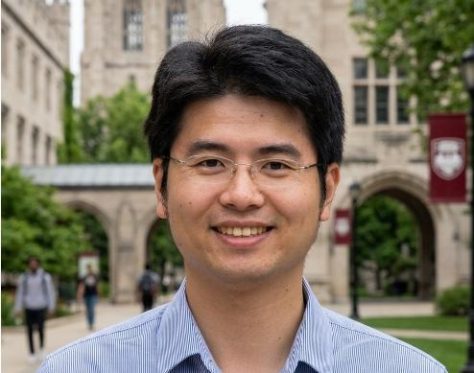
Speaker
Shuolong Yang
Assistant professor of molecular engineering, The University of Chicago
About This Talk
Engineering quantum materials at the atomic scale — through epitaxial growth or mechanical exfoliation — has driven a remarkable era of discovery in 2D electronics and quantum physics. A new frontier is now emerging: using ultrafast light pulses to create transient phases of matter not just in space, but also in time. This direction calls for new materials synthesis strategies, characterization tools, and an integration between materials design and ultrafast optical control.
Shuolong Yang will present two recent examples from his group at the University of Chicago. First, they grow monolayer MnBi₂Te₄ by molecular beam epitaxy and show that photoexcitation drives it into an exciton condensate — a collective quantum state of bound electron-hole pairs. Tracked by time- and angle-resolved photoemission spectroscopy (tr-ARPES), this condensate exhibits a 2D superfluid which persists up to 280 K. It can be continuously tuned between a fermionic (BCS-like) and bosonic (BEC-like) regime, offering a controllable platform for studying quantum phase transitions in 2D materials.
Second, they integrate topological insulator Bi₂Se₃ with a photonic crystal cavity to achieve spatiotemporal control over its electronic structure. The cavity confines the drive field to a 10×10 μm² footprint and extends the lifetime of light-dressed Floquet electronic states from ~300 fs to 2 ps, well beyond what free-space pulses allow. Their combined theoretical and experimental investigation shows that the spatiotemporal engineering of the Floquet states is robust against decoherence effects. This cavity-based approach offers a materials-level design strategy for programming and sustaining nonequilibrium topological phases, enabling photonics-driven nonequilibrium topological electronics.
About the Speaker
Shuolong Yang is an assistant professor of molecular engineering at the University of Chicago. He pioneered the approach to combine atomic-level materials synthesis with time-domain photoemission spectroscopy. He is recognized by an National Science Fountation CAREER award, a Department of Energy Early Career award, and a NASA Early Career Faculty award. He is a Gordon and Betty Moore Foundation investigator and was named a 2025 Emerging Investigator bythe journal Nanoscale.
About the MSE Seminar Series
The Materials Science and Engineering (MSE) Seminar Series features distinguished speakers from leading institutions, offering a platform for sharing groundbreaking research, innovative ideas, and entrepreneurial experiences. Held multiple times each semester, these seminars bring global perspectives world to MIT’s materials research community, exposing students, faculty, and postdocs to cutting-edge concepts and valuable networking opportunities.