Though This Be Disorder, Yet There Is Order in’t
Speaker
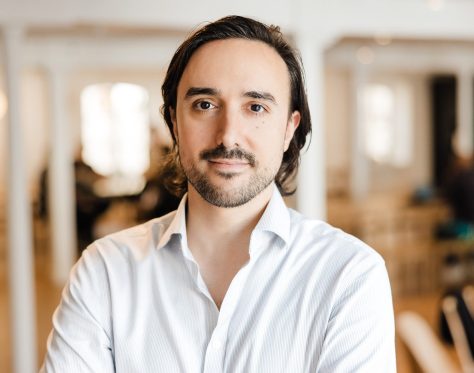
Stefano Martiniani
- Associate Professor of Physics, Chemistry, Mathematics, and Neural Science, New York University
About This Talk
In this talk, Stefano Martiniani of New York University will discuss the importance of understanding the relationship between structure and properties to designing materials with novel functions. Crystals have proven to be a highly versatile platform for engineering functions, as the periodicity of their atomic arrangement greatly facilitates the prediction and optimization of their properties. However, not all properties can be realized with periodic structures.
Martiniani will show how he and his research team established a new state of the art in the design of correlated disordered structures. This approach led to the discovery of a new class of disordered functional materials termed “gyromorphs,” which uniquely combine liquidlike translational disorder with quasi-long-range rotational order, induced by a ring of delta peaks in their structure factor. His research predicts that gyromorphs outperform all existing isotropic photonic bandgap materials, paving the way for fine control over optical properties. He will provide an outlook and discuss recent results on how the team is leveraging noisy processes to build generative AI models that will accelerate the discovery of novel materials across the periodic table. “Though this be madness, yet there is method in’t” (Hamlet II.ii).
About the Speaker
Stefano Martiniani is an associate professor of physics, chemistry, mathematics, and neural science at New York University. His interdisciplinary theory group develops AI methods to accelerate scientific discovery across molecules, materials, and living systems, and investigates organizing principles in complex systems.
He obtained his PhD at the University of Cambridge as a Gates Scholar, then held a postdoctoral appointment in physics at NYU (2017–2019) and an assistant professorship in chemical engineering and materials science at the University of Minnesota (2019–2021). His honors include the NSF CAREER and AFOSR YIP awards, the IUPAP Early Career Scientist Prize, Simons Foundation Faculty Fellowship, and University of Cambridge Outstanding Thesis Prize.