Scaling CsPbBr3 Single Crystals: Advances Toward Large-Volume Semiconductor Detectors for High Energy Gamma-rays
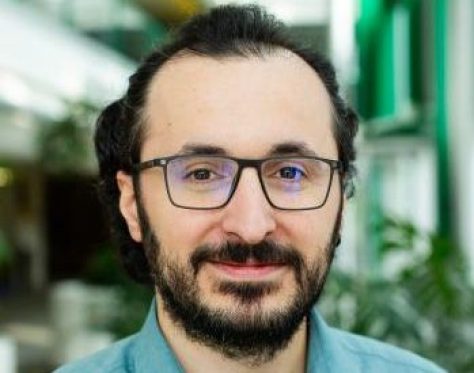
Speaker
Dr. Mustafa Unal
Materials Science Division, Argonne National Laboratory
About This Talk
High-resolution gamma-ray detectors provide an essential platform for advancing applications in nuclear security and nonproliferation, quantitative medical imaging techniques such as SPECT and PET, and high-energy astrophysical observations. Conventional semiconductor detectors (e.g., CdZnTe, HPGe) offer excellent energy resolution but face polarization effects, imbalanced charge transport, high cost, and manufacturing challenges. The all-inorganic halide perovskite CsPbBr3 has emerged as a promising alternative, combining balanced electron–hole transport, a relatively low melting point conducive to melt growth, and stable operation under high radiation flux. State-of-the-art small devices have achieved sub-1% FWHM energy resolution at 662 keV, and thick crystals have reached ~2.2% at 2.2 cm thickness. Yet scaling detector volume and ensuring long-term operational stability remain key challenges due to ion migration and environmental sensitivity. In this talk, I will present fabrication of 1.5 and 4.5 cm3 CsPbBr3 detectors, among the largest volumes reported, achieving spectral response as low as 6% FWHM at 662 keV in these large-format devices. I will then describe encapsulation strategies, including paraffin wax embedding and atomic layer deposition of thick Al2O3 coatings, that mitigate ion migration and environmental degradation. These approaches extend operational lifetimes beyond 90 days and deliver more than a threefold improvement relative to unencapsulated devices. Together, these advances trace a path toward scalable, robust perovskite gamma detectors, highlighting the balance between volume, resolution, and stability as key design parameters for future deployment across security, medical, and space applications.
About the Speaker
Dr. Mustafa Unal interests lie in the areas of thin film solar cells, semiconductor crystal growth and material characterization. He obtained his BSc degree from the Physics Department in 2014, and MSc and PhD degrees from Micro and Nanotechnology Graduate Program of Middle East Technical University, Türkiye. He has grown CdZnTe crystals for X-ray and gamma detection applications and joined Argonne National Laboratory in 2023 to work on the development of emerging radiation detection materials.